There is a version of urban nature that exists mainly in planning documents: green roofs on renderings, bioswales in cross-section diagrams, habitat corridors drawn as dashed lines on maps. And then there is the version people actually experience: the tree-lined street that makes a summer walk bearable, the waterfront path that turns a commute into something worth looking forward to.
The difference is execution. The places where nature feels integrated into daily life are the ones where someone followed through, where the trail connects to something, where the waterfront belongs to the public in practice. What follows are examples of communities where nature is woven into the everyday.
Ontario Waterfront Communities
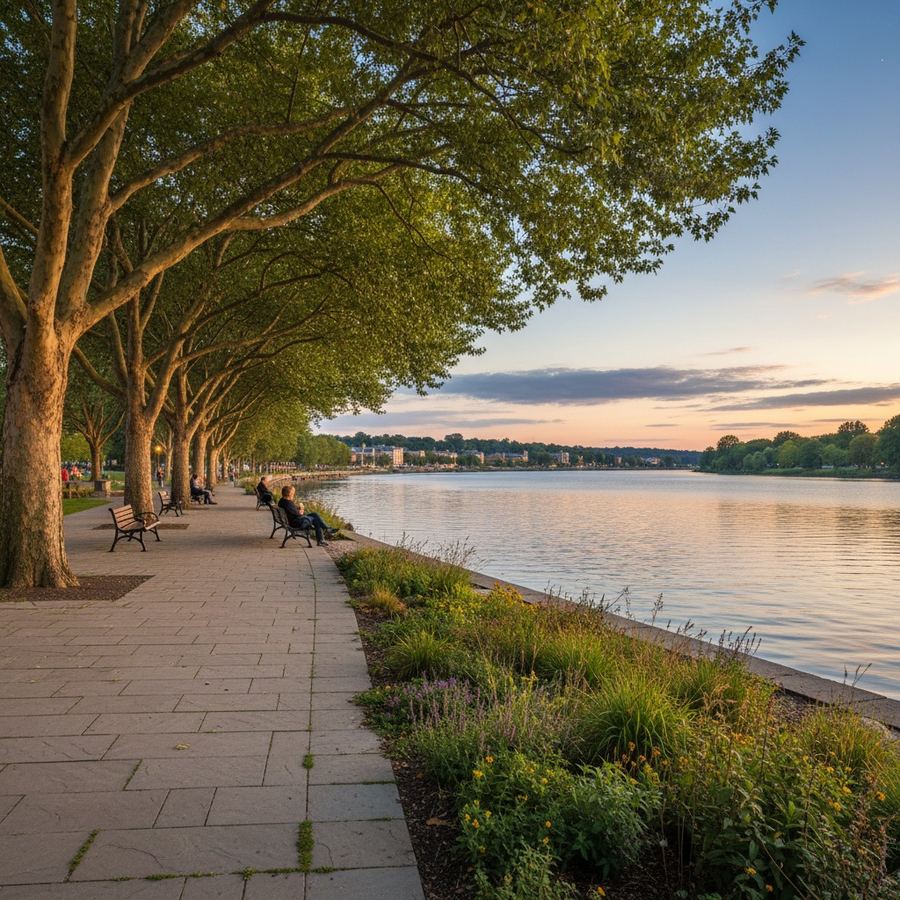
The most compelling local examples tend to be waterfront communities where geography forced the issue. When a town sits on a lake or river, the relationship between the built environment and the natural one is unavoidable. The question is whether the community treats that relationship as an asset or an afterthought.
Orillia, situated between Lake Simcoe and Lake Couchiching, has built a waterfront experience that functions as an extension of the downtown. The lakefront trail, parks, and public access points are not isolated amenities. They are part of the daily routine for residents who walk, cycle, or simply sit by the water as part of their normal lives. Community information through orillia.ca reflects a town that understands its waterfront as civic infrastructure rather than a tourism feature. The key is accessibility: the waterfront is reachable on foot from residential neighborhoods without requiring a car or a special trip.
Penetanguishene offers a different model but a similar principle. The town's harbor and waterfront areas have been developed with public access as a priority, and the connection between the commercial core and the water is direct enough that nature is simply part of the experience of being in town. Resources at penetanguishene.com document a community that has maintained public waterfront character despite development pressures that have eroded it elsewhere.
Wasaga Beach, known primarily as a summer destination, has a more complex story. The beach itself is a significant natural feature, and the community's relationship with it has evolved from pure recreation toward something more integrated, with increasing attention to dune preservation, naturalized areas, and year-round waterfront access. The trajectory documented at wasagabeach.net suggests a community working to balance natural preservation with public use, which is the central tension of waterfront integration everywhere.
What These Places Have in Common
The Ontario waterfront communities that succeed at nature integration share a few characteristics that are worth naming explicitly because they are replicable.
Continuous public access. The waterfront path or trail does not stop and start. You can walk for a meaningful distance without being diverted to a road or blocked by private property. Continuity is what transforms a waterfront from a destination into a daily-use amenity.
Mixed programming. The waterfront includes passive natural areas, active recreation spaces, and civic amenities like benches, washrooms, and gathering areas. This variety means different people use the waterfront for different reasons, which keeps it active throughout the day and across seasons.
Visible naturalization. Some portion of the waterfront is managed for ecological function rather than manicured appearance. Naturalized shorelines, native plantings, and habitat areas signal that the community values the waterfront as a living system, not just a scenic backdrop.
International Benchmarks
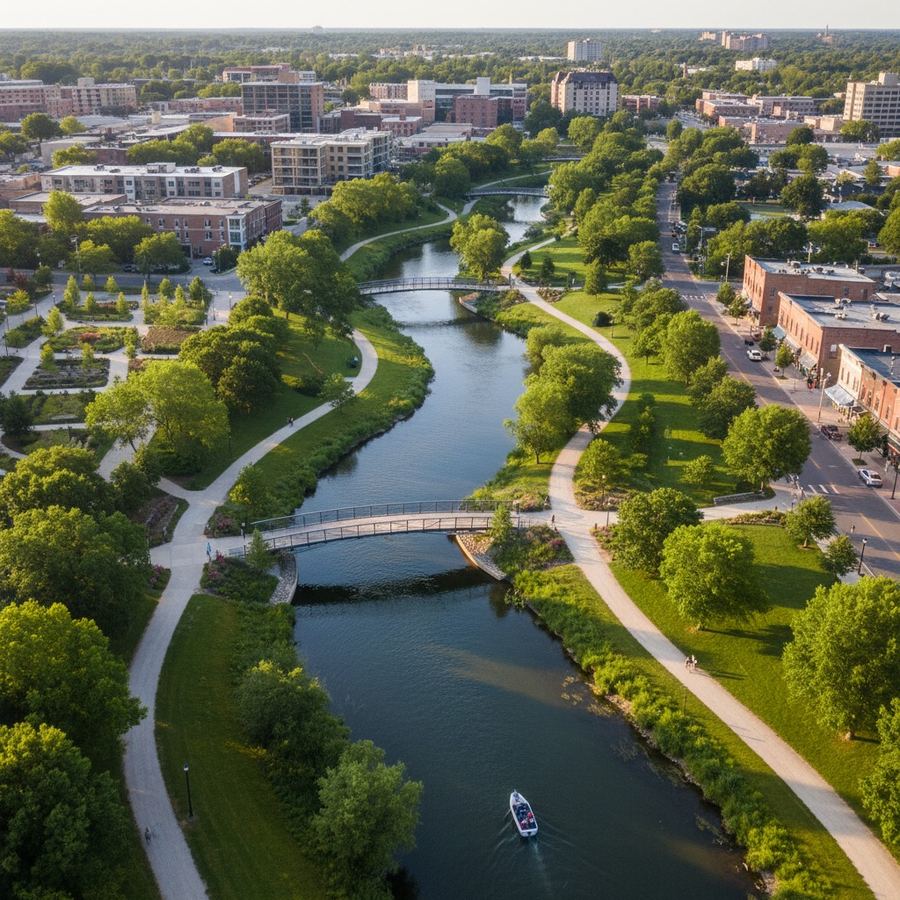
Looking beyond Ontario, several cities have become reference points for nature integration at a larger scale. These examples are useful not because small towns should replicate them directly, but because they demonstrate principles that work at any scale.
Portland, Oregon. Portland's network of urban greenways, the Forest Park trail system, and the integration of native landscaping into residential neighborhoods have made it a standard reference for urban nature in North America. What distinguishes Portland is not any single park or trail but the connectivity of the system. Green spaces are linked by bike routes, greenways, and street trees in a way that makes nature accessible from almost any neighborhood without driving.
Copenhagen, Denmark. Copenhagen has reimagined its harbor from an industrial waterfront to a public amenity where people swim, kayak, and gather year-round. The harbor baths at Islands Brygge, public pools built directly in the cleaned-up harbor, are a powerful symbol of what is possible when a city commits to water quality and public access simultaneously. Copenhagen also leads in integrating stormwater management into public parks, designing green spaces that double as flood retention areas during heavy rain.
Singapore. The city-state's "City in a Garden" vision has produced results that are visible at every scale, from the rooftop gardens on public housing to the Supertree structures at Gardens by the Bay. But the more replicable achievement is the Park Connector Network, a system of linked greenways that connects parks, nature reserves, and residential areas across the island. The principle is the same one that works in Orillia or Portland: connected green space that people use daily, not just on weekends.
Melbourne, Australia. Melbourne's urban forest strategy set a target of increasing canopy cover from 22 percent to 40 percent by 2040, with specific plans for every street. The strategy treats every street tree as infrastructure, with the same level of planning and maintenance commitment applied to trees as to pipes and roads. Melbourne also pioneered citizen participation in urban forestry by assigning email addresses to individual trees, inviting residents to report health concerns, which unexpectedly generated a flood of appreciative letters to trees, demonstrating public attachment to urban nature in a way that data alone could not.
The Neighborhood Scale
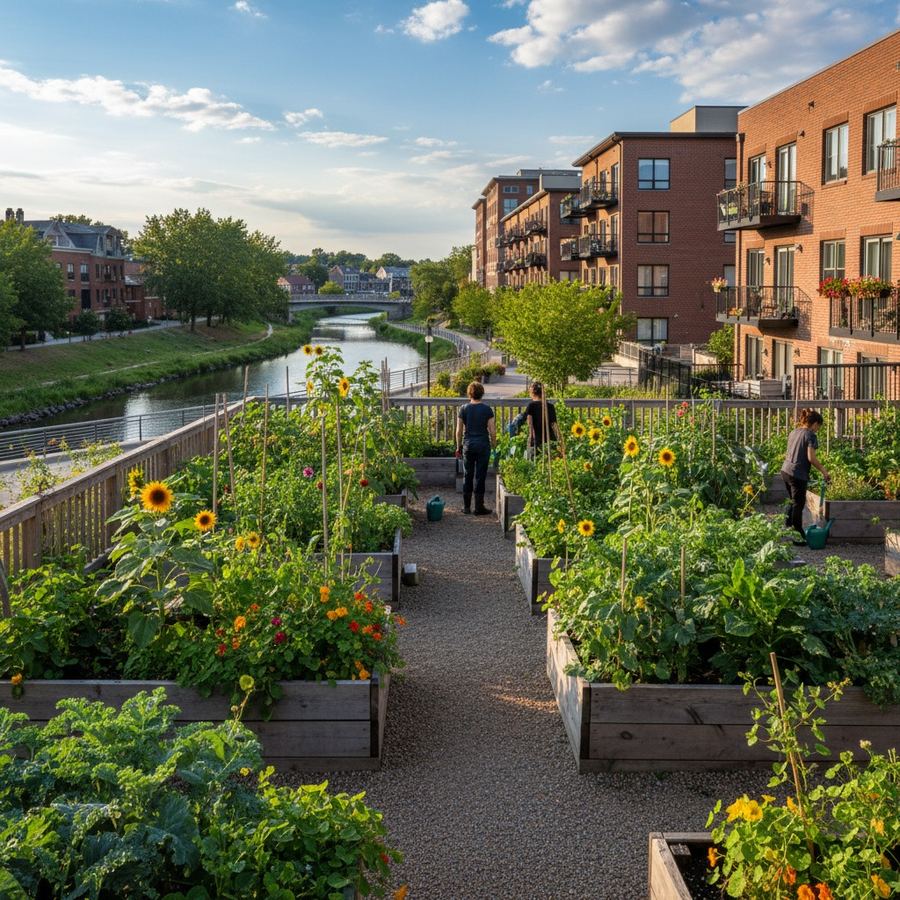
The most important examples of nature integration are often the smallest: a single street with a mature tree canopy, a neighborhood pocket park that functions as a de facto community center, a school garden that teaches children where food comes from, a naturalized stormwater feature in a parking lot that nobody notices until they learn what it does.
These small interventions work because they meet people where they are. Not everyone visits the waterfront. Not everyone uses the trail system. But almost everyone walks past a street tree, notices a garden, or benefits from the cooling effect of a nearby green space. The role of green space on main streets illustrates this principle: the greenery that matters most is not in the nature preserve on the edge of town but in the ordinary places where people spend their time.
What Prevents Integration
If the benefits of nature integration are well-documented and the examples are plentiful, why is it still rare? Several barriers recur across communities of every size.
Departmental silos. Parks, transportation, stormwater, and planning are separate departments with separate budgets. A street tree that benefits all four falls between jurisdictions, so nobody plants it.
Short political cycles. Trees take decades to mature. Elected officials on four-year terms face pressure to deliver visible results quickly, which favors ribbon-cuttings over slow, systemic investments in ecological infrastructure.
Maintenance avoidance. Building something green is politically appealing. Maintaining it is not. The communities that succeed at nature integration budget for maintenance from the beginning.
The "park" paradigm. Many communities still think of nature as something that belongs in bounded, maintained parks. Integrated nature requires a shift: trees belong on streets, stormwater belongs in gardens, wildlife corridors belong in neighborhoods.
Moving Forward
The examples above are not utopian. They are the result of specific decisions made by specific communities, often over long periods and against institutional resistance. The common thread is not wealth, geography, or political alignment. It is the decision to treat nature as infrastructure rather than decoration, and to invest in it accordingly.
For communities beginning this work, the most useful starting points are often the least dramatic: an audit of the existing tree canopy, a trail connectivity study, a stormwater management review that considers green alternatives, or a careful reading of a waterfront improvement plan to determine whether it genuinely prioritizes public access and ecological function.
The role of community groups in advocating for better public spaces is often decisive. Municipal staff can propose nature integration, but sustained community support is what ensures it survives budget debates, political transitions, and the inevitable pressure to pave things over in the name of efficiency. The best local examples exist because someone, usually a group of someones, insisted on them and kept insisting until they were built, maintained, and protected.