Resilience, in the urban context, means a community's capacity to handle environmental stress without falling apart. That includes heat waves, flooding, severe storms, and the slower shifts in temperature and precipitation patterns that change what is normal over time. It is not an abstract concept. It shows up in whether your street floods after two inches of rain, whether your neighborhood has shade in August, and whether the stormwater system was designed for conditions that no longer exist.
This section focuses on resilience at the neighborhood and street level, where most people actually experience environmental stress. That means topics like urban heat, surface materials, shade, floodplain management, and the role of community organizations in making neighborhoods more adaptive. We try to be practical rather than apocalyptic. Climate change is real and consequential, but the conversation about it does not need to be paralyzing. Many of the most effective resilience measures are also things that simply make neighborhoods more pleasant: more trees, better stormwater management, less impervious surface, and more functional green space.
The EPA has published useful guidance on urban heat islands and green infrastructure as resilience tools. Frameworks like the SITES rating system offer measurable standards for landscape performance that connect directly to resilience outcomes. At the local level, some of the most effective work is being done by community groups and small municipalities that do not make national headlines but are quietly adapting their infrastructure, lot by lot and block by block.
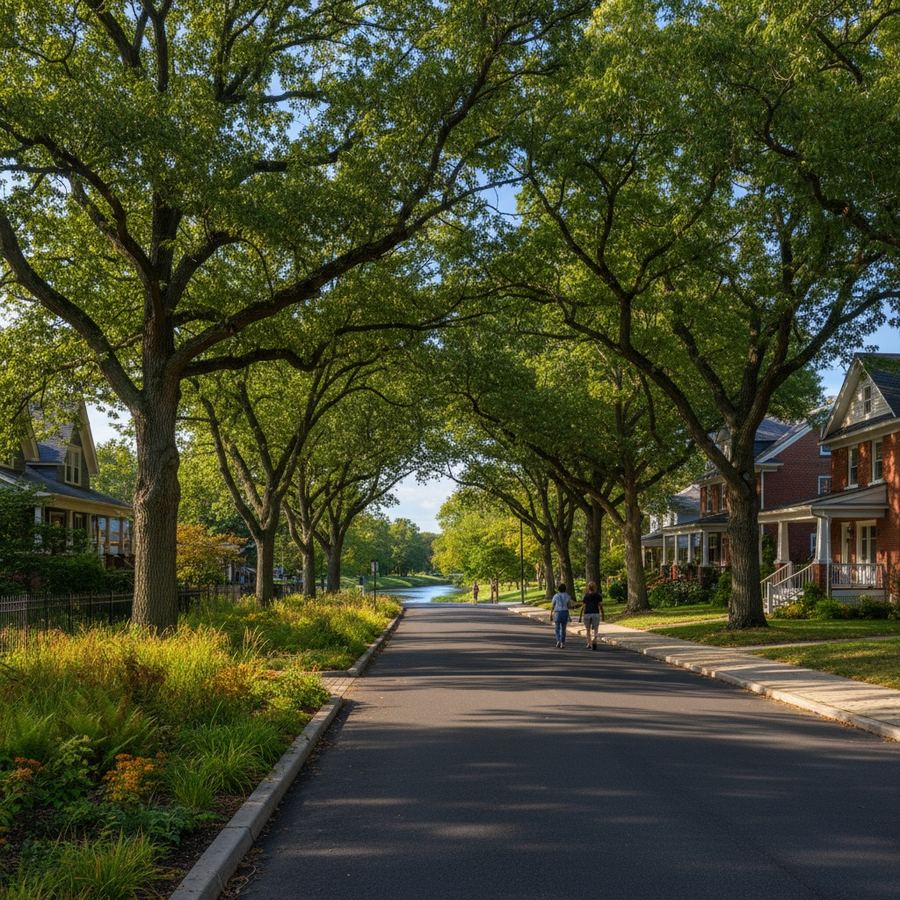
What connects these topics is the recognition that resilience is not primarily a federal or state-level concern. It plays out at the level of individual streets, lots, and drainage systems. A single block with mature tree canopy, permeable surfaces, and well-maintained stormwater infrastructure handles a heavy rain event differently than the block next to it with full impervious coverage and no shade. Those differences are measurable, and they are the product of decisions that communities can make right now, without waiting for large-scale policy changes.
Articles
What Climate Resilience Looks Like at Street Level
Resilience is not just a policy goal. It is visible in tree canopy, drainage, surface materials, and building orientation.
Trees, Shade, and Surface Materials Change Summer Heat
What actually drives urban heat at the street level, and why the solutions involve trees, pavement choices, and design more than most people expect.
Floodplain Thinking Without Turning Every Place Into a No-Go Zone
Flood risk is real, but managing it does not require abandoning every parcel near water. Better design and honest risk assessment go a long way.
How Community Groups Support Better Public Spaces
The volunteer organizations, friends groups, and neighborhood associations that do much of the real work on the ground.