Public space is where civic life happens. Not in theory, but in the concrete, everyday sense: the bench where someone eats lunch, the waterfront path people walk after work, the park where neighbors meet without needing a reason. When public space works well, it becomes so ordinary that nobody notices. When it fails, people feel the absence even if they cannot name it.
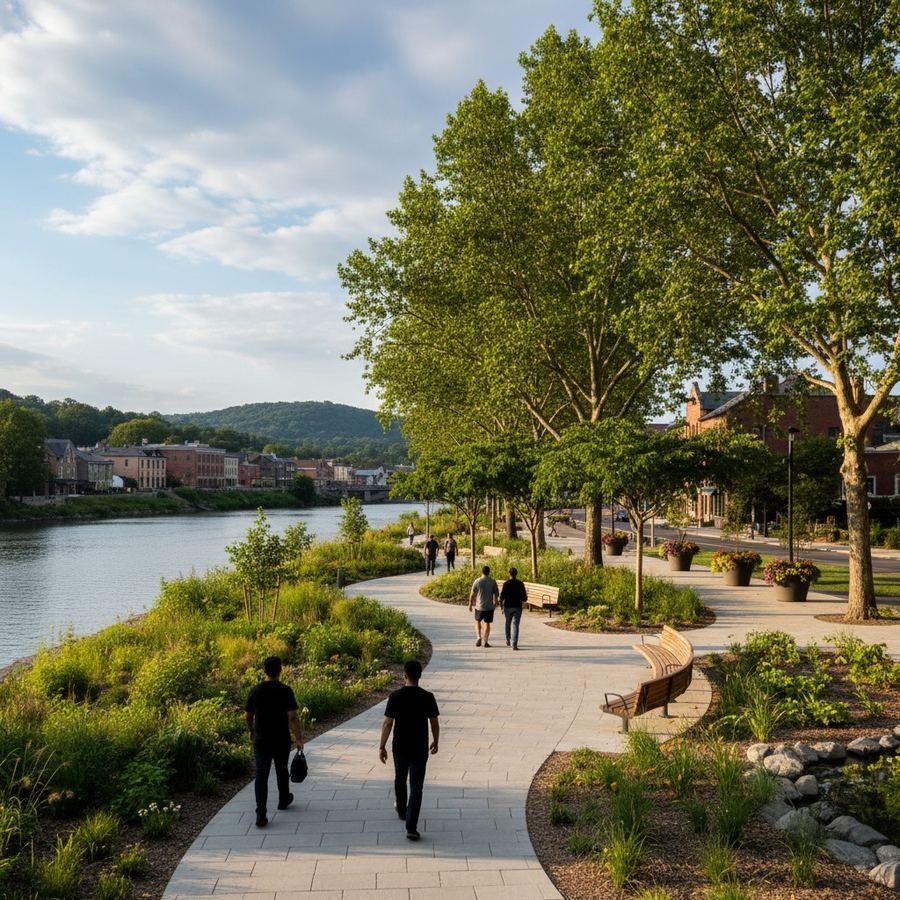
This section focuses on the design, access, and governance of shared spaces in cities and towns. We are interested in what makes a waterfront genuinely public rather than technically public. We look at why some parks feel connected to their neighborhoods while others sit isolated behind arterial roads and parking lots. We examine the tension between private development and public access along urban waterfronts and riverfronts, which remains one of the most consequential land-use questions in many communities.
Scale matters here. Much of the writing about public space focuses on major cities with large budgets and high-profile design firms. But most Americans live in places where the public space conversation is about a town square that needs repaving, a riverbank that could become a trail, or a main street where pedestrians compete with four lanes of traffic. The Trust for Public Land's 10-minute walk initiative has helped frame this conversation productively, and frameworks like LEED for Neighborhood Development offer useful benchmarks. But the starting point should always be whether a space works for the people who actually use it.
Good public space is not accidental. It results from deliberate choices about access, connectivity, comfort, and maintenance. A streetscape that prioritizes pedestrian shade and seating over traffic throughput is a choice. A waterfront that includes continuous public access instead of handing every parcel to private developers is a choice. The articles in this section examine those choices and what follows from them.
Articles
Designing Better Waterfront Access
What separates a waterfront that works from one that only looks good in renderings. Access, continuity, and genuine public use.
Connected Parks Instead of Isolated Parks
A park surrounded by parking lots and stroads is harder to reach and less useful than one knitted into the surrounding neighborhood.
Public Access vs. Private Control Along Urban Water
Rivers and lakefronts belong to everyone in principle. In practice, the story is more complicated.
Why Small Cities Need Public Space Strategy
A town of 15,000 people benefits from thoughtful public space planning just as much as a city of a million.
Better Streetscapes Start with Human Comfort
Shade, seating, protection from traffic, and walkable surfaces are not amenities. They are the baseline.