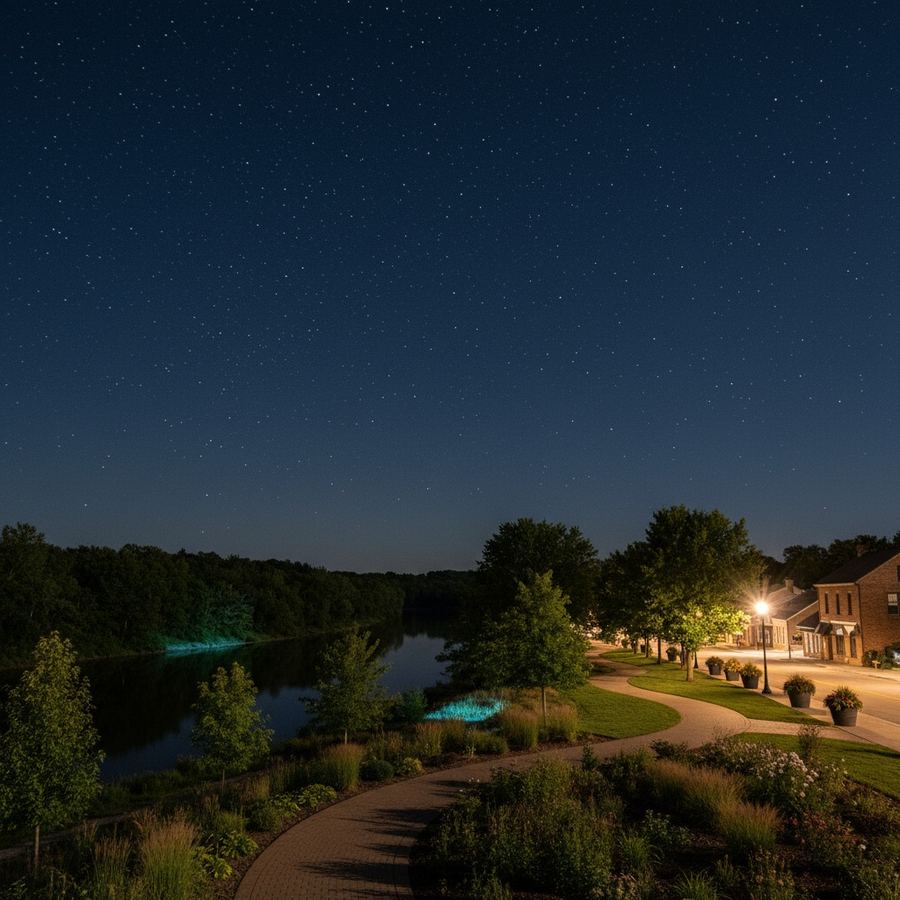
Over decades, the night sky above most communities has faded from a field of stars to a pale orange glow. The Milky Way is now invisible to more than a third of the world's population. In most of southern Ontario, you cannot see it without driving at least an hour from the nearest city.
The consequences of excessive artificial light extend far beyond lost stargazing. Light pollution affects human health, disrupts wildlife, wastes energy, and degrades the character of communities in ways that are measurable and largely preventable. The problem is not that we use light at night. It is that we use it badly.
What Light Pollution Actually Is
Light pollution is the result of poorly designed, misdirected, or excessive artificial lighting. The most visible form is skyglow, the dome of light that hangs over every city and town. Skyglow is caused by light aimed upward or sideways rather than downward, where it is needed.
Then there is glare, the harsh brightness from unshielded lights that makes it harder to see rather than easier. And light trespass, where light from one property spills onto another, is familiar to anyone whose bedroom is lit up by a neighbor's security light.
The Health Case
Human biology is built around the cycle of light and darkness. The hormone melatonin, which regulates sleep and supports immune function, is produced in response to darkness. Exposure to artificial light at night, particularly the blue-rich white light emitted by modern LEDs, suppresses melatonin production.
Disrupted sleep is associated with increased risk of cardiovascular disease, diabetes, obesity, and depression. The American Medical Association has warned about the health risks of high-intensity LED streetlights, recommending warmer-toned lights (3000 Kelvin or below) and minimal blue-spectrum emissions.
This does not mean all outdoor lighting is harmful. A well-shielded, warm-toned streetlight that illuminates the sidewalk without flooding bedrooms is fine. A 5000K LED fixture that turns an entire block blue-white is a public health decision, whether or not anyone framed it that way.
Wildlife in the Dark
For most of the animal kingdom, darkness is not an absence. It is a habitat. Bats, moths, owls, frogs, fireflies, and many migratory songbirds depend on natural darkness to navigate, hunt, mate, and migrate.
Artificial light disrupts all of these behaviors. Moths circle lights until they die of exhaustion. Migratory birds become disoriented by brightly lit buildings, a phenomenon that kills hundreds of millions of birds annually in North America. Frogs use darkness as a cue for breeding calls, and artificial light suppresses their activity.
The ecological case for reducing light pollution is not about turning off the lights. It is about ensuring that artificial light stays where it is needed, on roads, paths, and building entrances, rather than flooding the surrounding landscape. Communities that maintain functional natural areas within their boundaries have a particular responsibility to ensure that those areas are not degraded by adjacent lighting.
The Energy Waste
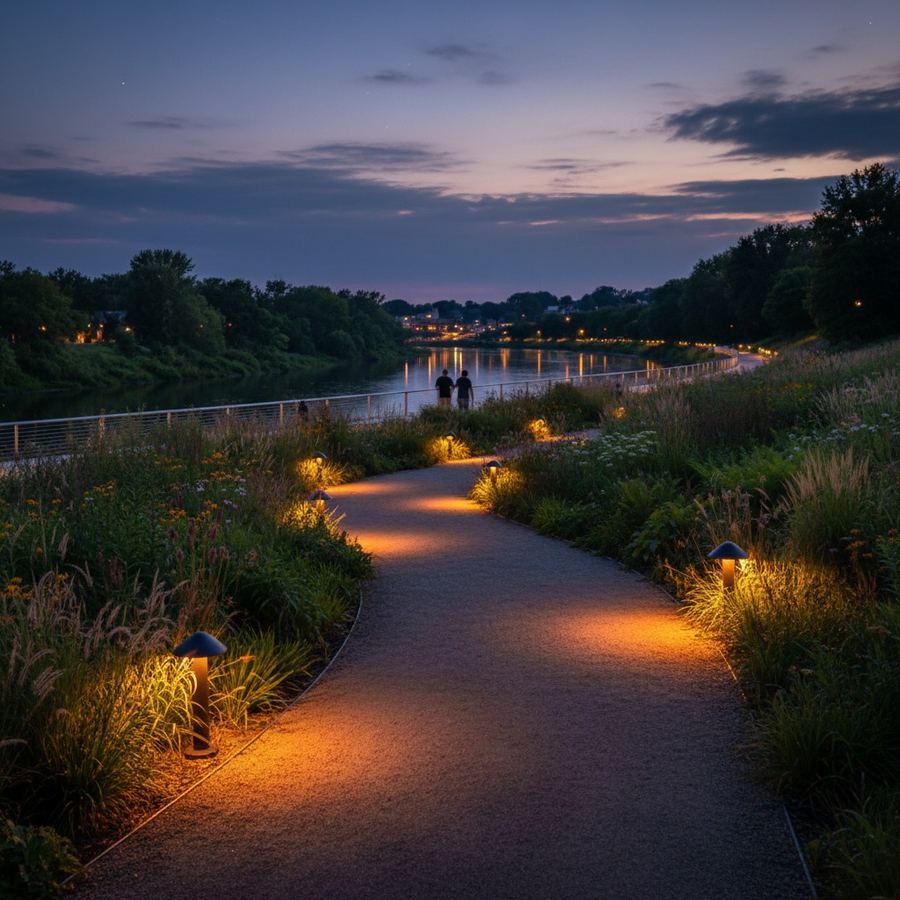
Poorly designed lighting wastes energy by definition. Light that goes into the sky illuminates nothing. Light that floods a parking lot at twice the necessary intensity uses twice the necessary electricity. The International Dark-Sky Association (darksky.org) estimates that at least 30 percent of all outdoor lighting in the United States is wasted, amounting to roughly $3.3 billion in unnecessary energy costs per year.
For municipalities, this waste shows up directly in operating budgets. The transition from sodium-vapor to LED lighting offered an opportunity to reduce both energy use and light pollution. Unfortunately, many municipalities chose the cheapest LED fixtures, which tend to be high-intensity, blue-white, and unshielded.
The better approach, recommended by darksky.org and the Illuminating Engineering Society, is to install fully shielded fixtures rated at 3000K or below, use adaptive controls that dim lights during low-traffic hours, and light only the areas that need it.
What Smarter Lighting Looks Like
The communities that have addressed light pollution effectively share common practices. None involve making places darker in ways that compromise safety. Well-designed lighting actually improves safety by reducing glare and improving visibility.
Full shielding. Every outdoor fixture should direct light downward. No light should be emitted above the horizontal plane. This single change, applied consistently, eliminates most skyglow contribution from municipal lighting.
Warm color temperature. Lights rated at 3000K or below produce a warm white or amber tone that is less disruptive to human sleep and wildlife behavior than the 4000K-5000K blue-white LEDs commonly used in commercial and municipal installations.
Appropriate intensity. More light is not always safer. Overlighting a parking lot or street creates harsh contrasts between lit and unlit areas, making it harder for eyes to adjust and harder to see into shadows. Uniform, moderate lighting is both safer and more pleasant.
Adaptive controls. Dimming lights during low-traffic hours, typically between 11 p.m. and 5 a.m., reduces energy use and light pollution without affecting safety during the hours when most people are asleep. Motion-activated lighting in low-traffic areas achieves the same goal.
Lighting ordinances. A growing number of municipalities have adopted outdoor lighting ordinances that set standards for shielding, color temperature, and intensity. These ordinances do not eliminate outdoor lighting. They ensure that new installations meet basic standards, and they provide a framework for replacing the worst existing fixtures over time.
The Community Character Argument
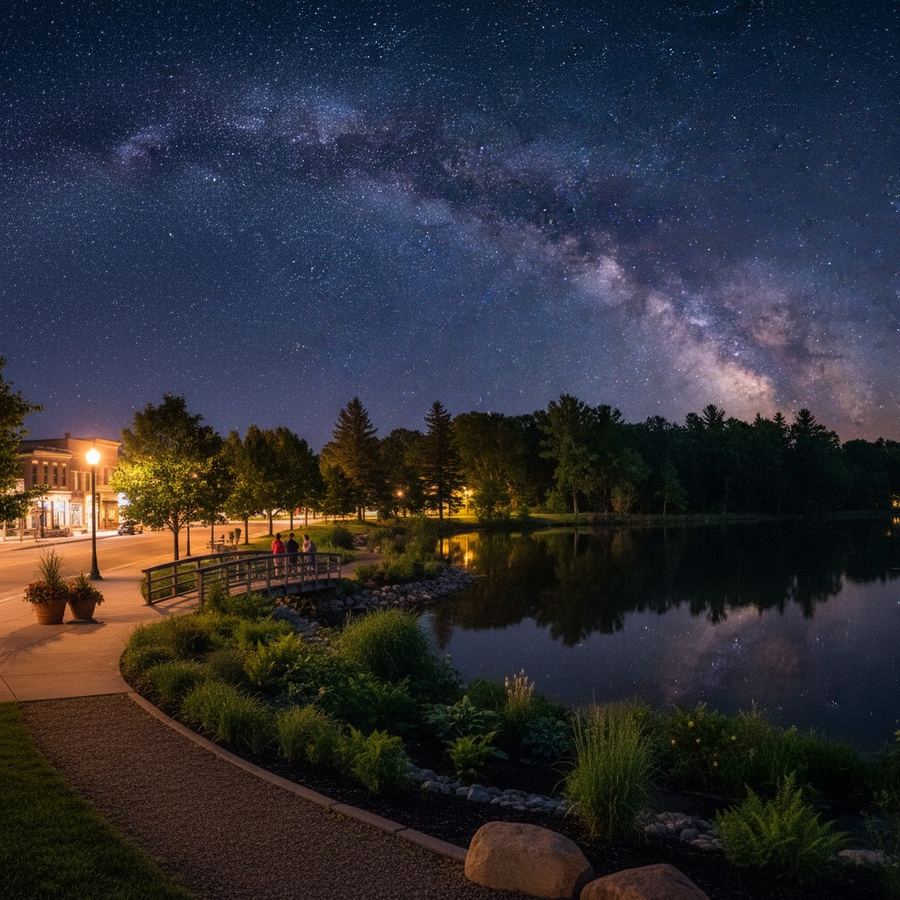
Beyond health, ecology, and energy, there is a simpler argument for darker nights: they make communities more pleasant to live in. A town where you can see the stars from your backyard, where the evening walk is lit by warm, gentle light rather than harsh floodlamps, where the transition from day to night is a gradual dimming rather than an abrupt switch from sunlight to sodium glare, is a town with a quality that is difficult to quantify but easy to feel.
This quality has economic value. Communities with dark sky designations, including several in Ontario, report increased tourism from stargazing, astro-photography, and visitors seeking an experience that is increasingly rare. But even without a formal designation, the simple act of improving lighting quality makes a town more comfortable for its residents, which is, after all, the primary purpose of municipal infrastructure.
What Residents Can Do
Individual actions matter here more than in most environmental issues, because a significant portion of light pollution comes from private property: residential security lights, commercial signage, decorative lighting, and unshielded porch lights.
Replacing an unshielded floodlight with a shielded, motion-activated fixture costs very little and immediately reduces light trespass onto neighboring properties and into the sky. Choosing warm-toned bulbs (2700K-3000K) over cool-white LEDs improves the light quality for everyone nearby. Turning off unnecessary outdoor lights after midnight is free.
At the municipal level, residents can advocate for lighting standards during development reviews. When a new project is proposed, the lighting plan is part of the site plan approval process. Asking for shielded fixtures and warm color temperatures is straightforward, because good lighting design generally costs the same as bad lighting design.
For a broader view, community groups are often the catalyst for municipal lighting improvements. And the questions to ask about revitalization projects include lighting as a detail that reveals whether a project prioritizes community quality.
Darker nights are not a step backward. They are a correction. The technology to light communities safely without polluting the sky already exists. The only thing missing is the decision to use it.