The conventional approach to parks in American cities follows a simple formula. Find available land. Build a park. Move on. The result, repeated over decades, is a collection of green spaces scattered across a community with no particular relationship to each other. Each park is surrounded by roads, parking lots, and buildings. Each one is a green island in a gray sea.
This approach is better than having no parks at all. But it leaves significant value on the table. The research on urban green space, accumulated over two decades by ecologists and public health researchers, points consistently toward the same conclusion: connected parks outperform isolated ones on nearly every measure that matters.
What Connection Means
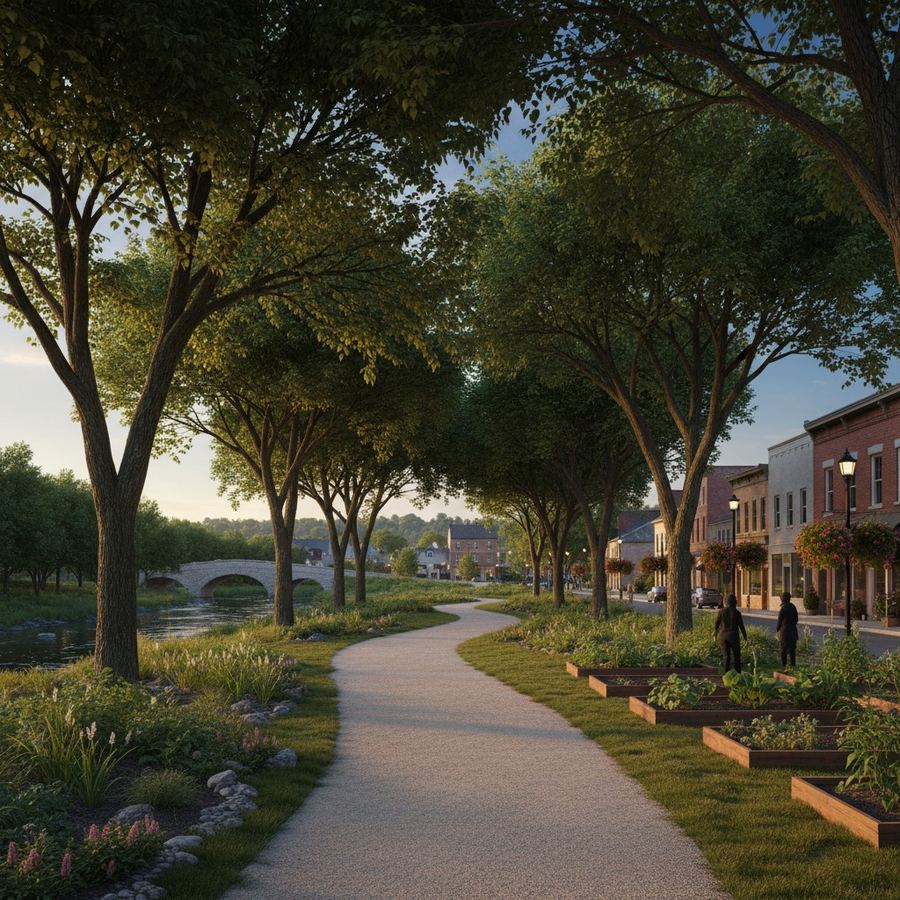
A connected park system is one in which green spaces are linked to each other by corridors that allow both people and wildlife to move between them. These corridors might be greenways along streams, tree-lined boulevards, rail trails, utility easements with restored vegetation, or even wide planted medians. The key feature is continuity. A person or an animal can travel from one green space to another without having to cross a hostile landscape of fast roads and barren pavement.
This idea is not new. Frederick Law Olmsted designed his park systems as networks, not collections. The Emerald Necklace in Boston linked a chain of parks and natural areas into a continuous green corridor. It was designed in the 1880s, and it remains among the most valued public landscapes in the city.
What is newer is the scientific understanding of why connection matters so much for the ecological and public health functions that parks are increasingly expected to provide.
The Ecological Case
Island biogeography, the study of species distribution on isolated patches of habitat, provides the foundational science here. Research by E.O. Wilson and Robert MacArthur in the 1960s established that isolated habitat patches lose species over time. The smaller and more isolated the patch, the faster the loss. This principle applies to urban parks just as it applies to oceanic islands.
An isolated five-acre park in a city can support a limited number of bird, insect, and plant species. Over time, local populations experience random declines, and because the park is isolated, there is no way for new individuals to arrive from neighboring habitat. Species wink out one by one. The park becomes biologically simplified, dominated by generalist species that tolerate urban conditions.
Connect that same park to other green spaces through a vegetated corridor, and the dynamic changes. A species that declines in one park can be replenished by arrivals from another. Genetic diversity is maintained. Research published in the journal Landscape Ecology has shown that urban bird diversity correlates more strongly with habitat connectivity than with the total area of green space in a city. The connections make the difference.
The Human Case
For people, connected parks solve a practical problem. An isolated park serves the neighborhood immediately surrounding it. Everyone else has to drive there. A connected park network, linked by trails and greenways, becomes accessible to a much larger population on foot or by bike. The park system becomes a transportation system, not just a collection of destinations.
This has direct implications for equity. Research from the National Recreation and Park Association has documented that access to parks is unevenly distributed by income and race. A connected network can partially address this by making distant parks reachable without a car. A greenway that runs through several neighborhoods effectively extends each neighborhood's access to include every park on the network.
The health implications are substantial. Studies from the University of Exeter have found that people are more likely to meet physical activity guidelines when they have access to connected green spaces for walking and cycling, compared to isolated parks that require a specific trip.
What Cities Are Getting Right
Several cities have moved beyond the isolated-park model and invested deliberately in connection.
Minneapolis has one of the most connected park systems in the country. The Grand Rounds National Scenic Byway links a chain of parks and lakes through a 50-mile network of parkways and paths. No single park in the system is extraordinary on its own. Together, they form something that no individual park could replicate.
The Atlanta BeltLine is a more recent example. Built on a 22-mile loop of former rail corridors, the BeltLine connects 45 neighborhoods and links dozens of parks into a continuous network. Before the BeltLine, many of these parks were effectively invisible, accessible only by car from specific streets. The trail has made them part of a connected system, and usage has increased dramatically.
In smaller communities, the principle works the same way at a different scale. Greenville, South Carolina invested in the Swamp Rabbit Trail, a 22-mile greenway connecting parks, schools, and commercial districts along an old railroad corridor. The trail turned a collection of independent parks into a single recreational and transportation network.
The Corridor as Park
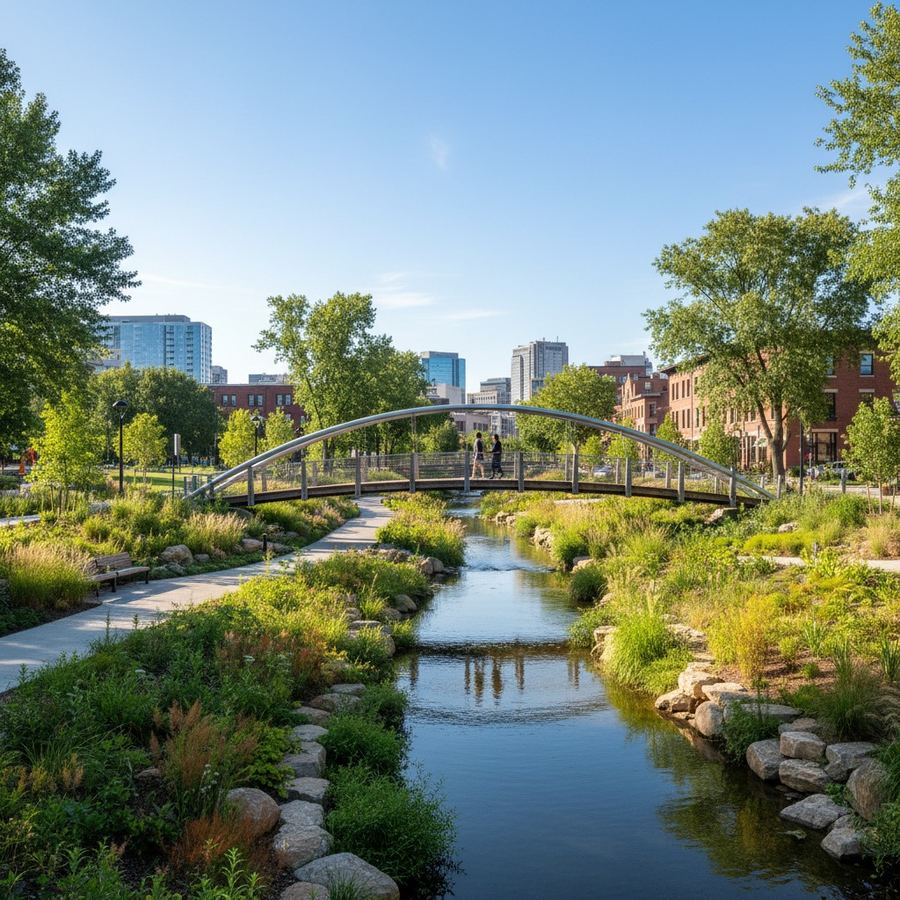
One of the most important shifts in thinking about connected parks is the recognition that the corridors themselves are green spaces. A well-designed greenway is not just a path between parks. It is a linear park in its own right, with its own ecological functions, its own recreational value, and its own role in supporting both people and wildlife.
This reframing matters for budgeting and maintenance. If a connecting greenway is treated as infrastructure, like a road, it gets a budget line and a maintenance crew. If it is treated as an afterthought, it deteriorates. The communities that have the best connected park systems are the ones that assign the corridors the same institutional status as the parks they connect.
Obstacles and Realities
The main obstacle to building connected park systems is land. Corridors require continuous strips of accessible land, and in developed areas, those strips are often fragmented by private property and roads. Assembling a continuous corridor can take years.
Stream corridors and floodplains offer the most natural opportunities for connection, because they are often already publicly owned or subject to development restrictions. River corridors in particular provide a ready-made framework for connecting green spaces. Utility easements and abandoned rail lines are other common opportunities.
Cost is a real factor, but connected park systems do not necessarily cost more than isolated parks. A 30-foot-wide greenway with a paved trail and native vegetation costs far less per acre than a fully developed neighborhood park with playgrounds and sports fields. The investment is in length and continuity rather than in programmed features.
Starting from Where You Are
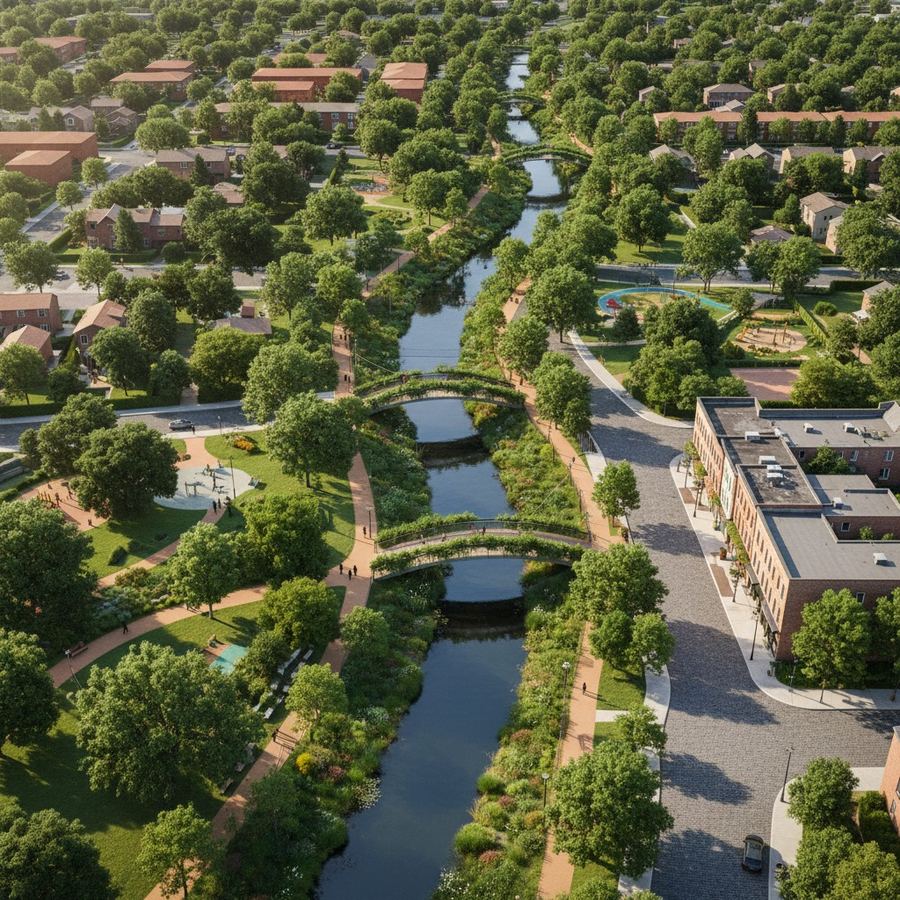
Most communities already have the raw materials for a connected park system. The parks exist. Stream corridors exist. Abandoned rail lines or utility easements may be available. The challenge is seeing these elements as parts of a potential network rather than as independent features.
A useful first step is to map every public green space in the community and every potential corridor between them. Overlay that map with population data, and the priorities become visible. Where are the largest gaps in access? Which connections would serve the most people?
This kind of analysis does not require expensive consultants. It requires someone willing to look at the green space system as a system rather than as a list of individual projects. The shift from thinking in parks to thinking in networks is the most important change a community can make. What is usually missing is the vision of connection itself.
Olmsted understood this 150 years ago. The science has since confirmed what his design intuition suggested: isolated patches of nature in cities are inherently fragile, while connected systems are resilient, productive, and far more useful to the communities they serve. The question for every community with parks is whether the next investment will add another island or build a bridge.