When people talk about great public spaces, the examples tend to be the same: Central Park, the High Line, Millennium Park, the San Antonio River Walk. These are big-city projects with big budgets and national reputations. They set the imagination, but they can also create the impression that serious public space planning is something only large cities do, that smaller cities and towns should focus on more "practical" concerns and leave the placemaking to the metros.
That impression is wrong. Small cities, towns with populations of 10,000 to 100,000, benefit from thoughtful public space planning at least as much as their larger counterparts, and in some respects more. The margins are thinner. The competition for residents, businesses, and investment is fiercer. And the difference between a community that feels alive and one that feels like it is quietly declining often comes down to the quality of its shared spaces.
The Stakes Are Higher Than They Appear
A large city can absorb a neglected waterfront or a poorly maintained park system and still attract residents and investment through sheer economic gravity. A small city cannot. In communities where young adults are deciding whether to stay or leave, where remote workers are choosing among dozens of comparably priced towns, and where retirees are evaluating quality of life, the public realm becomes a decisive factor.
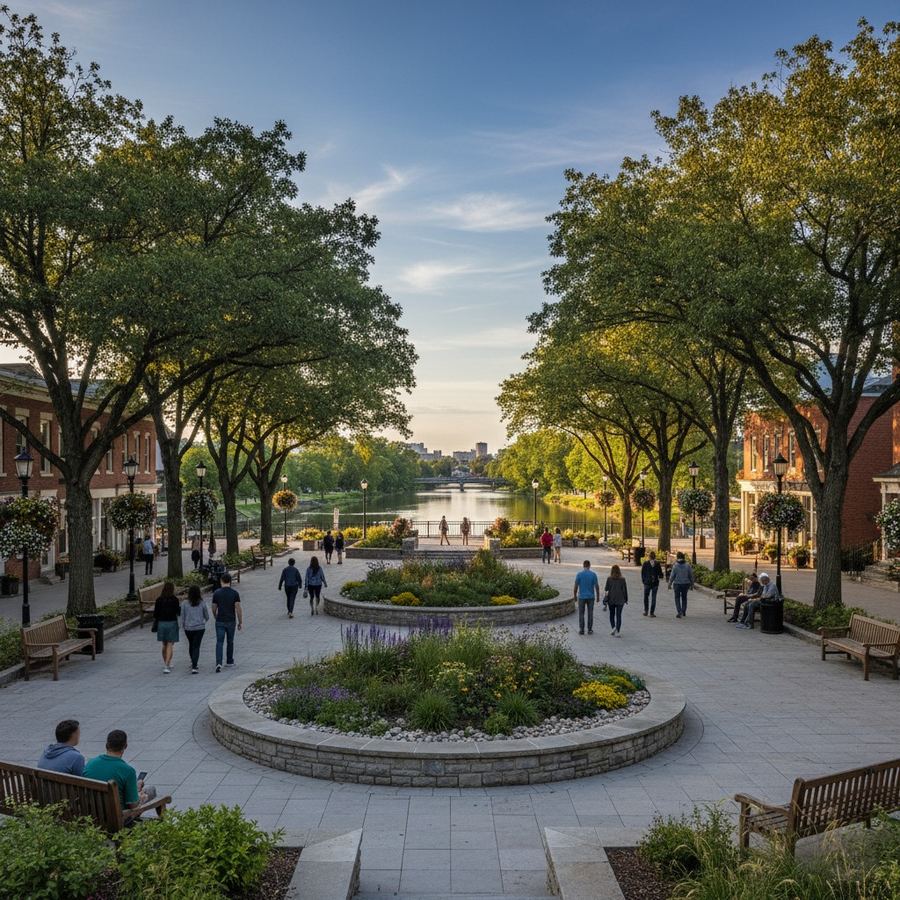
A town with a walkable main street, a functioning park system, a waterfront trail, and a few well-designed gathering spaces communicates something about itself: that it values civic life, that it invests in shared amenities, and that it cares about the experience of the people who live there. A town without those things communicates the opposite, regardless of its tax rates or school test scores.
What Public Space Strategy Means at a Small Scale
Public space strategy for a small city is not about building the next High Line. It is about being intentional with the spaces the community already has. Most small cities have a handful of parks, a downtown, a waterfront or stream corridor, and a collection of streetscapes that together form the public realm. The question is whether those spaces work as a system or exist as disconnected, undermaintained afterthoughts.
A basic public space strategy might address questions like: Are the downtown sidewalks wide enough and comfortable enough to encourage walking and lingering? Does the park system serve all neighborhoods, or are some areas underserved? Is there public access to the waterfront, and is it connected to the trail system? Are there gathering spaces that support community events, farmers markets, and informal socializing? Is the tree canopy adequate to make outdoor spaces comfortable in summer?
These are not expensive questions to answer. A small city can develop a public space framework with modest consultant costs or, in some cases, through engaged volunteer efforts and partnerships with regional planning organizations.
Parks as a System
Many small cities have parks that were established decades ago and have not been evaluated as a system since. A park system assessment looks at distribution (does every neighborhood have a park within walking distance?), condition (are facilities maintained and updated?), programming (do the parks offer what residents actually want?), and connectivity (can residents walk or bike safely from one park to another?).
The Trust for Public Land's 10-minute walk campaign has focused on ensuring that every resident lives within a 10-minute walk of a quality park. In small cities, achieving this standard is often more feasible than in large ones, because the distances involved are smaller and the land costs are lower. A single well-placed pocket park or trail connection can close a significant gap in park access.
Connected park systems outperform collections of isolated parks. When parks are linked by trails, greenways, or even improved sidewalks, they become more useful individually and collectively. A family that can walk from a neighborhood park to a waterfront trail to a downtown plaza has a fundamentally different experience than one confined to a single park surrounded by parking lots.
Waterfronts and Main Streets
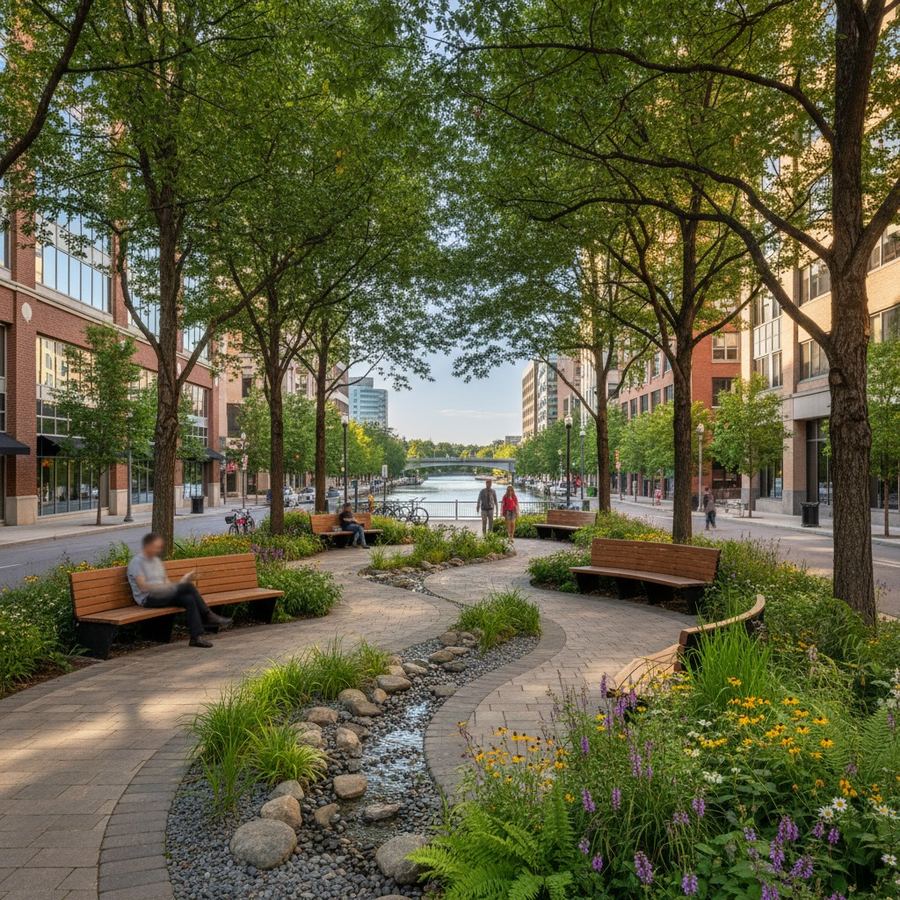
Two of the most common and most underutilized public space assets in small cities are waterfronts and main streets. Many small towns grew up along rivers or lakes and then spent decades turning their backs on the water, allowing industrial uses, private development, or simple neglect to cut residents off from what should be a shared civic asset.
Reclaiming waterfront access does not require massive investment. A simple trail, a canoe launch, a restored riparian buffer with benches and overlooks, these modest interventions can transform a community's relationship with its waterfront. The key is ensuring public access and maintaining it over time.
Main streets, similarly, are public spaces that many small cities have allowed to deteriorate. A main street with wide sidewalks, street trees, outdoor seating, and active storefronts functions as the community's living room. A main street with narrow, cracked sidewalks, no shade, and empty buildings functions as a daily reminder of decline. The investment required to shift from the second condition to the first is often surprisingly modest relative to the return in civic pride, foot traffic, and business viability.
The Economic Case
Small cities that invest in public space see measurable economic returns. Property values near quality parks and trails increase. Main streets with improved streetscapes attract more businesses and customers. Waterfront improvements generate tourism and recreation spending. These effects are documented across communities of all sizes, from the Rails-to-Trails Conservancy's research on trail economics to the Trust for Public Land's analyses of park-adjacent property values.
The economic case also includes talent attraction and retention. In an economy where many workers have geographic flexibility, the quality of a community's public realm is a competitive advantage. A connected trail system, a revitalized main street, and a welcoming park system are tangible reasons for people to choose one community over another.
Getting Started
A small city does not need a million-dollar planning process to begin improving its public spaces. It needs a clear-eyed assessment of what exists, a conversation with residents about what is missing, and a willingness to start with small, visible improvements that build momentum and public support.
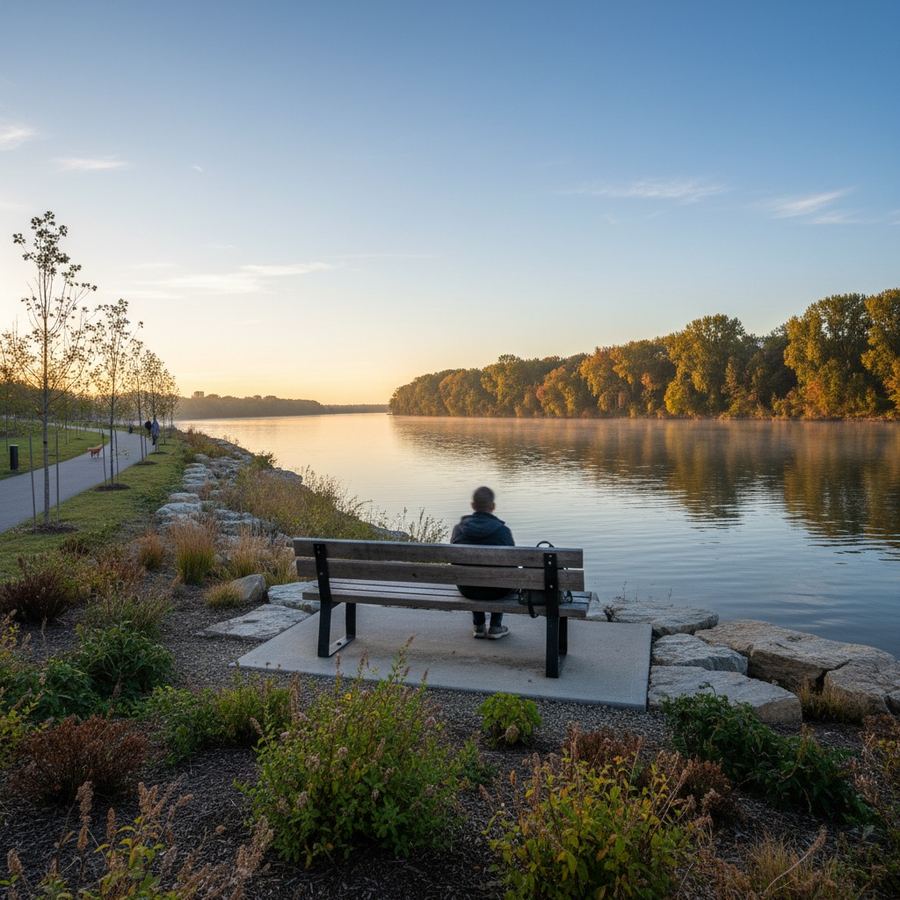
Plant street trees on the main commercial corridor. Build a quarter-mile trail segment that connects a neighborhood to the waterfront. Add benches and native plantings to an underused park. Fix the sidewalks between the school and the park. These actions cost relatively little, but they signal intent and begin to shift how residents and visitors experience the community.
Public space strategy is not a luxury for large cities with large budgets. It is a practical tool for any community that wants to remain a good place to live. The small cities that invest in their shared spaces, thoughtfully and consistently, will be the ones that thrive.