There is a type of green space that does not look like a park and rarely appears in tourism brochures. It is the green corridor: a linear strip of vegetation and habitat that follows a river, an abandoned rail line, a power line easement, or a creek valley through developed land. These corridors are narrow, often only a few dozen yards wide. They are rarely destinations in themselves. But they may be the most important category of urban green space for both ecological function and everyday human use.
The reason is simple. Corridors connect things. In a landscape fragmented by roads and parking lots, a continuous strip of vegetation is the difference between isolated habitat patches and a functioning ecological network. For people, that same strip of green is the difference between a neighborhood with no way to walk to the next one and a community linked by a safe, car-free route.
The Ecology of Narrow Spaces
It is reasonable to wonder whether a strip of trees along a creek, maybe 50 or 100 feet wide, actually provides meaningful habitat. The answer from decades of research is a clear yes, though with important qualifications.
A study published in Conservation Biology found that urban riparian corridors as narrow as 30 meters supported significantly higher bird diversity than surrounding developed areas. The corridor does not need to be wide enough to contain a full ecosystem. It needs to be continuous enough to allow movement. Birds, small mammals, insects, and amphibians use these corridors as travel routes between larger patches of habitat. The corridor is the highway. The parks and preserves at either end are the destinations.
This movement function is critical. When habitat patches become completely isolated, the populations within them become genetically isolated. Small, isolated populations are vulnerable to inbreeding, disease, and random events. A corridor that allows even occasional movement between patches maintains genetic exchange and allows recolonization after local losses. The concept is straightforward: connected populations are more resilient than isolated ones.
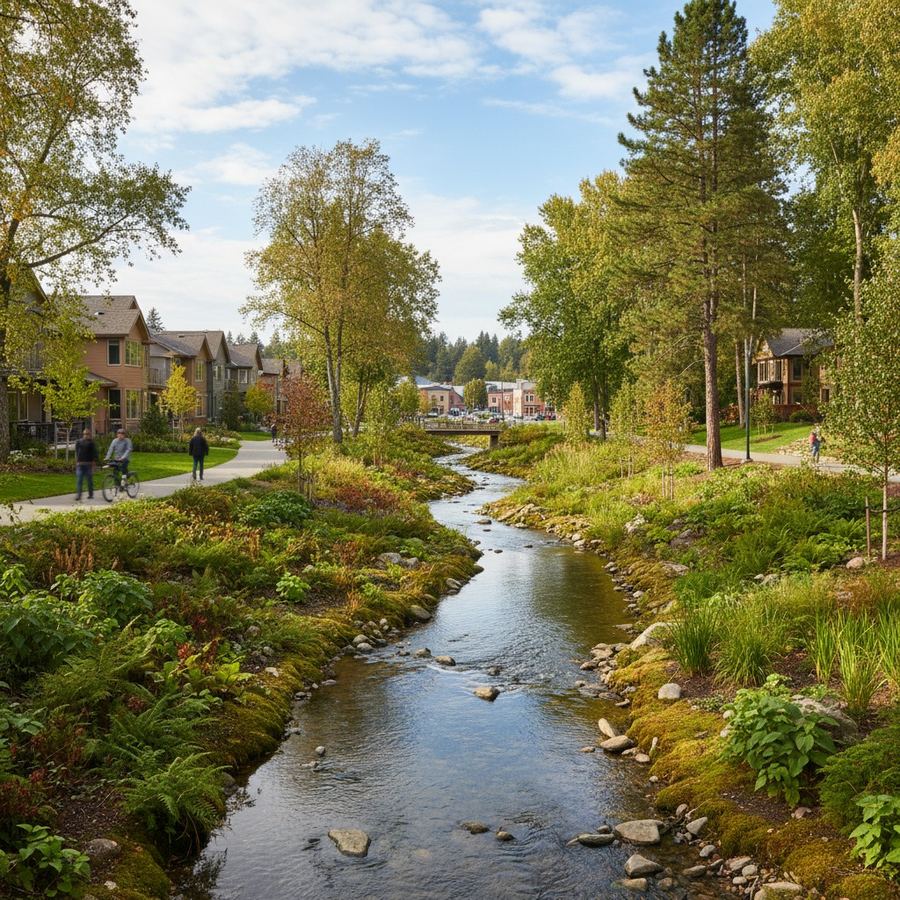
Plant communities benefit from corridors as well, though on longer time scales. Seeds travel along waterways, on animal fur, and on wind currents that follow linear openings in the canopy. Research from the Smithsonian Environmental Research Center has documented plant migration along riparian corridors at rates that significantly exceed migration across fragmented landscapes.
What Makes a Corridor Work Ecologically
Not all green corridors are equal as habitat. Several design factors determine whether a corridor functions as a genuine ecological connection or merely as a decorative green stripe.
Width matters, but continuity matters more. A wider corridor supports more species. But a narrow corridor with no gaps is more useful than a wide one with breaks. Even short gaps of bare pavement can stop many species from crossing. The priority should be eliminating breaks first and widening the corridor second.
Vegetation structure determines who can use it. A corridor with only mowed grass under a row of shade trees provides minimal habitat. A corridor with canopy trees, understory shrubs, ground cover, and leaf litter supports far more species. The vertical complexity of the vegetation is as important as the horizontal extent. Native plant species are strongly preferred because they support more insect species, which in turn support everything else.
Water features amplify the value. Corridors that follow streams or include wetland areas provide habitat for aquatic species that cannot survive in upland conditions. Riparian corridors are consistently the most ecologically productive type of urban green corridor, with stormwater management benefits that upland corridors lack.
Connections at both ends matter. A corridor that leads to a parking lot at one end and a highway at the other is a dead end. The most valuable corridors connect to larger habitat areas, other corridors, or other green spaces that together form a network. This is the same principle that makes connected park systems more effective than isolated ones.
The Human Side
Green corridors serve people through many of the same properties that make them useful for wildlife. The continuity that allows a bird to travel between habitat patches also allows a person to walk or bike from one neighborhood to another without encountering a busy road.
Rail trails are the most familiar example. The conversion of abandoned railroad rights-of-way into multi-use trails has created thousands of miles of green corridors across the country. These corridors work well because railroads were engineered for gentle grades and continuous routes, exactly the properties that make a good walking and cycling path. The Katy Trail in Missouri and the Great Allegheny Passage in Pennsylvania are well-known examples, but smaller rail trails may deliver even greater per-capita value because they provide connectivity that would otherwise not exist.
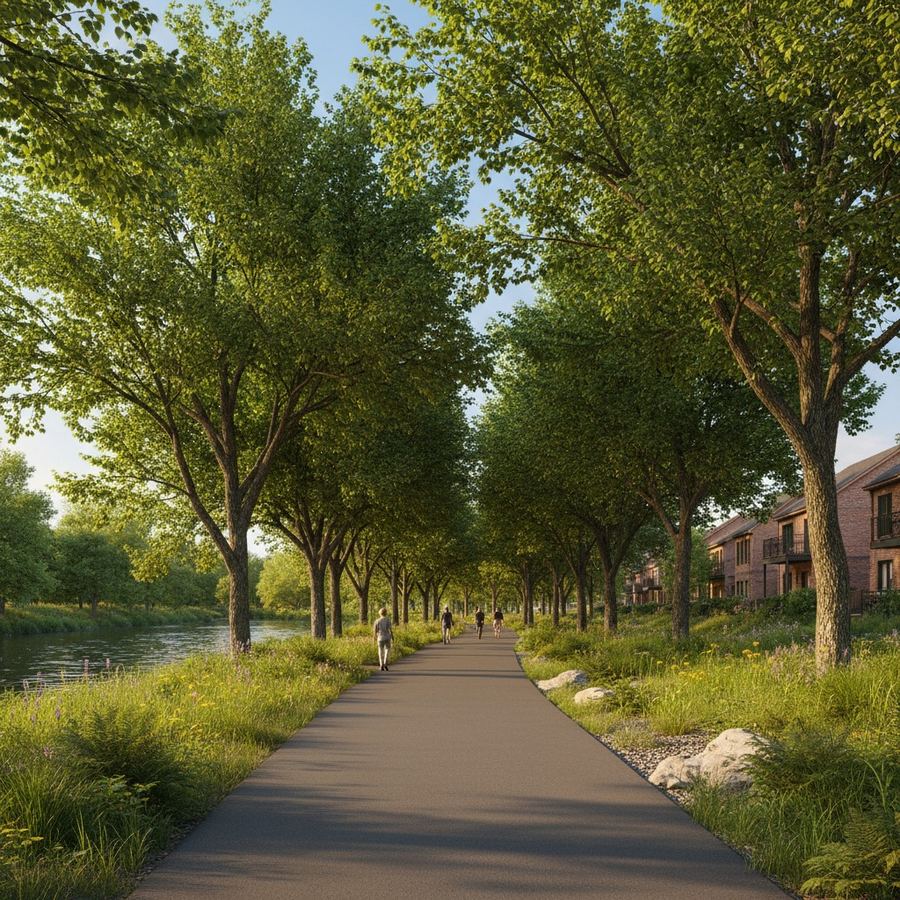
River corridors serve a similar function. The Boise River Greenbelt, the San Antonio River Walk extensions, and the Schuylkill River Trail in Philadelphia all demonstrate how river corridors can function as both ecological habitat and primary transportation routes.
Utility easements represent an underused opportunity. Power line corridors and gas pipeline easements often run for miles through developed areas, typically maintained as mowed grass. With modest investment in native vegetation and a simple trail, these corridors can provide both habitat connectivity and human mobility. Montgomery County, Maryland has converted segments of utility corridors into pollinator habitat with trails, demonstrating that the two uses are compatible.
Managing the Tension
There is a legitimate question about whether human use and wildlife habitat can coexist in a narrow corridor. The honest answer is that it depends on the design. A 10-foot paved trail running down the center of a 40-foot corridor leaves little room for meaningful habitat. The same trail along one edge of a 150-foot corridor leaves most of the space available for vegetation and wildlife, while bringing people into proximity with nature.
Research from Colorado State University has found that wildlife disturbance from trails decreases rapidly with distance. Most sensitive species avoid an area within about 50 meters of a regularly used trail but are unaffected beyond that distance. Other design strategies help as well: keeping dogs on leash, minimizing lighting in habitat areas, and using vegetation to discourage off-trail access. The goal is not to exclude people from the corridor but to design the shared space so that both uses function well.
Why Corridors Deserve Investment
Green corridors are efficient. They provide ecological connectivity, recreational access, stormwater management, and urban nature experience in a relatively small footprint. A 100-foot-wide corridor running two miles through a city occupies about 24 acres, less land than many single-purpose parks, but the linear form delivers benefits across a much larger area because it touches more neighborhoods and connects more destinations.
Corridors are also easy to create incrementally. A community can start by protecting the most critical segment, then extend over time as land becomes available. Each segment adds value to the whole.

The challenge is that corridors do not fit neatly into conventional categories. They are not parks, not preserves, not roads. They fall between the jurisdictions of parks departments, transportation agencies, and environmental offices. Getting institutional support for corridors often means convincing multiple agencies that the corridor serves their goals.
Communities that have made that case successfully, places like Fayetteville, Arkansas and Chattanooga, Tennessee, have found that green corridors become among the most valued public spaces in the city. They provide something that conventional parks and roads do not: a continuous, shared space that works for a walk to the store and for a migrating warbler looking for a place to rest.
The land for these corridors often already exists in the form of stream buffers, rail rights-of-way, and utility easements. The question is whether communities see that land as leftover space or as the connective tissue that makes everything else work better. The evidence strongly favors the second view.